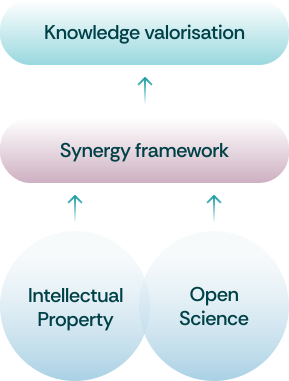
The European research and innovation landscape demands robust strategies for knowledge valorisation, aiming to translate scientific outputs into economic and societal benefits. This dual objective requires aligning Intellectual Property protection with the principles of Open Science, often perceived as conflicting forces.
The IP4OS project is addressing this fundamental tension through the development of the Synergy Framework. Its core mission is to operationalise the principle of “as open as possible, as closed as necessary” by mapping and formalising the relationship between IP and OS.
Access the Synergy Framework for Knowledge Valorisation here
The Synergy Framework is co-created through a rigorous, three-strand methodological approach, ensuring its recommendations are grounded in both academic insight and practitioner experience.
A comprehensive review of academic literature was conducted to trace precisely where OS and IP converge or conflict, identifying existing mechanisms for reconciliation.
A cross-sectional survey collected perceptions from researchers, technology transfer offices, research managers, and policy actors across Europe, confirming perceptions of complementarity but highlighting practical barriers.
This involved dialogues and webinars with legal scholars, IP professionals, and OS practitioners, who presented real-world cases and agreed upon criteria for identifying ‘fit-for-purpose’ IP tools.
Although stakeholders expressed widespread optimism that IP and OS can be complementary (82 per cent of survey respondents agreed this synergy is possible), the practical implementation remains limited.
Our research identified several critical barriers that hinder effective alignment:
The Synergy Framework addresses the gaps and barriers identified by providing clear recommendations and identifying fitting and non-fitting tools designed to empower multi-professional teams and their organisations: